Thursday, 29 May 2008


Sunday, 18 May 2008
Notes from an Exhibition - Patrick Gale
Patrick Gale, I tend to think, writes in a mixture of styles - Joanna Trolloppe crossed with Anne Tyler. His books are Aga Sagas but with a touch more emphasis on family tensions and resolutions. In this book each chapter begins with a review of a picture produced by the central character - Rachel Kelly. Through each member of the family the history of this woman's life

emerges. As usial with Patrick Gale things are never quite what they seem. Rachel has a history of mental illness - but is it postnatal depression, or do the roots go deeper. She's married to a Quaker, and has children, each of whom has a story - a man desperate for a child with his wife, a gay son with an older partner, currently going through problems of jealosy, another son who died and a daughter who disappeared suffering from depression or something else. Here are the elements of an Anne Tyler novel but the resolution is typical Joanna Trolloppe. The loose ends are all fairly neatly tied. You do get a real feeling of the bipolar condition, and its treatment, and the reactions of others to it. This isn't great literature, and not particularly taxing - but it is pleasing and satisfying. Rating: 7/10
Sunday, 11 May 2008
Michael Tolliver Lives - Armistead Maupin
Now I was really looking forward to this book. I had greatly enjoyed The Tales of the City series written by Armistead Maupin about two decades ago. 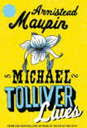 The earlier books were light, easy reads.
 The earlier books were light, easy reads.
They described the lives of a disparate group of lodgers at the house of grand dame Anna Madrigal in San Francisco - all (including the landlady) have secrets and have come to the City by the bay to find themselves, and escape their past. The lives were bizarre, and the stories, episodic, wry, funny and punchy quickly drew you into the characters and made them seem like your friends. This book (overshadowed as it is by the after-effects and consequences of AIDS) is far more preachy, almost bitter and confronting. It centres on one of the characters from the earlier book - a survivor of the AIDS epidemic, and whereas in the first books Michael Tolliver conducts us through the bitter sweet emotions of falling in and out of love, romance and getting by financially, now Mr Maupin seems to want to flaunt the sexual behaviour in enormous detail, and without much humour. Even his relationship with his unforgiving mother almost has an element of revenge as she approaches her death. All in all a pity Armistead decided to expand a much loved series in this substandard way. What a pity! Rating 5/10
Wednesday, 30 April 2008
The Selfish Gene - Richard Dawkins

Now I don't often read science books - but this at least was relatively short, and I kept asking myself how much of this is science, and how much philosophy? Richard Dawkins is man on a mission - extremely anti religion. So, he starts out by saying that everyone now accepts Darwinism as fact - therefore all religious belief must be erroneous. I get the feeling he is falling into the same trap that he accuses those of faith of having fallen into. A Christian believes that God created the world (and does this belief really exclude Darwinism?) whereas Dawkins believes in the continuing effect of genetic development. What he fails to explain is where, what or who began the process of the development of life. Anyway, having skimmed over all that, he seeks to demonstrate that it is the genetic imperative in all lifeforms (and he isn't neglectful of every possible species - bees, wasps, seahorses, cuckoos, gazelles, urchins, all get a look in) that affects every aspect of life. Therefore, no life form every does an 'altruistic' act, without subconsciously the genes thinking 'What's in this for me?' All genes are thinking about are how do I achieve immortality - passing on through the generations, adapting, intermixing and so on. He fobs off group support as fallacious, a mere mask for genes seeking their survival into breeding and therefore continuous. Parents caring for their children? No - genes ensuring that they survive through to grandchildren. I'm sorry it is too simple - and maybe that was his intention, science for the non-scientific. Rating 5/10
Saturday, 19 April 2008
Kafka on the Shore - Haruki Murakami
OK - lets start with the positive - this is quite an easy read - I managed to finish it in just over a week. It also seems to be a reasonable translation - fairly free rather than literal, and only the occasional strange 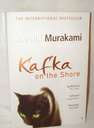 use of words. Now I come to the negatives - and I wonder if I have a difficulty with Japanese culture - perhaps these kinds of story are common in that country. I had trouble working out whether this is a fantasy, soft porn, crime thriller, suspense, horror, some kind of spiritual, mystical musing, or a study in psychosis. What is the plot? Well here I had trouble getting to grips with the story line. The central character 'Kafka' (a 15 year old) seems to live in a world of his own - is hearing voices, or having conversations with an imaginary friend. He runs away from home and then has a series of 'incidents' involving a quest to find his mother and sister, a visit to a strange library, several sexual encounters, a flying saucer. an old man who talks to cats, a journey into a secret land in the woods, a mystical entrance stone, some obviously hallucinatory experiences. I found some of the scenes unpleasant, others irritating, and yet more totally silly. Another week of my life I'll never get back.... Rating 5/10
use of words. Now I come to the negatives - and I wonder if I have a difficulty with Japanese culture - perhaps these kinds of story are common in that country. I had trouble working out whether this is a fantasy, soft porn, crime thriller, suspense, horror, some kind of spiritual, mystical musing, or a study in psychosis. What is the plot? Well here I had trouble getting to grips with the story line. The central character 'Kafka' (a 15 year old) seems to live in a world of his own - is hearing voices, or having conversations with an imaginary friend. He runs away from home and then has a series of 'incidents' involving a quest to find his mother and sister, a visit to a strange library, several sexual encounters, a flying saucer. an old man who talks to cats, a journey into a secret land in the woods, a mystical entrance stone, some obviously hallucinatory experiences. I found some of the scenes unpleasant, others irritating, and yet more totally silly. Another week of my life I'll never get back.... Rating 5/10
Tuesday, 8 April 2008
One Good Turn - Kate Atkinson
The second in the series begun with Case Histories (see a blog entry below). I'd really enjoyed the first book featuring Jackson Brodie so looked forward to this volume immensely. 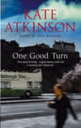

I have to say it doesn't start in a sparkling way - it seems to meander and you begin to wonder where the whole thing is going - but not in a good way. Rather like in Case Histories this book looks from the viewpoints of several characters, linked very loosely to Jackson Brodie, ex-army, former policeman, previously a private investigator and by this time independently wealthy (as explained in the previous book). He is also going through complicated (and not smooth ) personal relationships. This time there is one incident that each character is involved with, (road rage in Central Edinburgh) but as you would expect in a thriller (and this is in many ways a traditional thriller) there are many twists and turns, and nobody (and nothing) is quite what it seems. So after a shaky start Ms Atkinson gets into her stride, and this proves to be a real page turner - she is so good at developing characters without over writing, you care about what happens to even the minor and fleeting people - you want to 'good' guys to succeed and the 'bad guys' to lose - and some do spectacularly. The author is much better at female characters than male - and I wonder if she'll need to look at Jackson Brodie a little more closely to make some of his actions and emotions more credible. Still a worthy 7/10
Subscribe to:
Posts (Atom)