 use of words. Now I come to the negatives - and I wonder if I have a difficulty with Japanese culture - perhaps these kinds of story are common in that country. I had trouble working out whether this is a fantasy, soft porn, crime thriller, suspense, horror, some kind of spiritual, mystical musing, or a study in psychosis. What is the plot? Well here I had trouble getting to grips with the story line. The central character 'Kafka' (a 15 year old) seems to live in a world of his own - is hearing voices, or having conversations with an imaginary friend. He runs away from home and then has a series of 'incidents' involving a quest to find his mother and sister, a visit to a strange library, several sexual encounters, a flying saucer. an old man who talks to cats, a journey into a secret land in the woods, a mystical entrance stone, some obviously hallucinatory experiences. I found some of the scenes unpleasant, others irritating, and yet more totally silly. Another week of my life I'll never get back.... Rating 5/10
Saturday, 19 April 2008
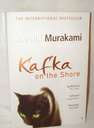
Kafka on the Shore - Haruki Murakami
OK - lets start with the positive - this is quite an easy read - I managed to finish it in just over a week. It also seems to be a reasonable translation - fairly free rather than literal, and only the occasional strange use of words. Now I come to the negatives - and I wonder if I have a difficulty with Japanese culture - perhaps these kinds of story are common in that country. I had trouble working out whether this is a fantasy, soft porn, crime thriller, suspense, horror, some kind of spiritual, mystical musing, or a study in psychosis. What is the plot? Well here I had trouble getting to grips with the story line. The central character 'Kafka' (a 15 year old) seems to live in a world of his own - is hearing voices, or having conversations with an imaginary friend. He runs away from home and then has a series of 'incidents' involving a quest to find his mother and sister, a visit to a strange library, several sexual encounters, a flying saucer. an old man who talks to cats, a journey into a secret land in the woods, a mystical entrance stone, some obviously hallucinatory experiences. I found some of the scenes unpleasant, others irritating, and yet more totally silly. Another week of my life I'll never get back.... Rating 5/10
use of words. Now I come to the negatives - and I wonder if I have a difficulty with Japanese culture - perhaps these kinds of story are common in that country. I had trouble working out whether this is a fantasy, soft porn, crime thriller, suspense, horror, some kind of spiritual, mystical musing, or a study in psychosis. What is the plot? Well here I had trouble getting to grips with the story line. The central character 'Kafka' (a 15 year old) seems to live in a world of his own - is hearing voices, or having conversations with an imaginary friend. He runs away from home and then has a series of 'incidents' involving a quest to find his mother and sister, a visit to a strange library, several sexual encounters, a flying saucer. an old man who talks to cats, a journey into a secret land in the woods, a mystical entrance stone, some obviously hallucinatory experiences. I found some of the scenes unpleasant, others irritating, and yet more totally silly. Another week of my life I'll never get back.... Rating 5/10


Tuesday, 8 April 2008
One Good Turn - Kate Atkinson
The second in the series begun with Case Histories (see a blog entry below). I'd really enjoyed the first book featuring Jackson Brodie so looked forward to this volume immensely. 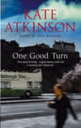

I have to say it doesn't start in a sparkling way - it seems to meander and you begin to wonder where the whole thing is going - but not in a good way. Rather like in Case Histories this book looks from the viewpoints of several characters, linked very loosely to Jackson Brodie, ex-army, former policeman, previously a private investigator and by this time independently wealthy (as explained in the previous book). He is also going through complicated (and not smooth ) personal relationships. This time there is one incident that each character is involved with, (road rage in Central Edinburgh) but as you would expect in a thriller (and this is in many ways a traditional thriller) there are many twists and turns, and nobody (and nothing) is quite what it seems. So after a shaky start Ms Atkinson gets into her stride, and this proves to be a real page turner - she is so good at developing characters without over writing, you care about what happens to even the minor and fleeting people - you want to 'good' guys to succeed and the 'bad guys' to lose - and some do spectacularly. The author is much better at female characters than male - and I wonder if she'll need to look at Jackson Brodie a little more closely to make some of his actions and emotions more credible. Still a worthy 7/10
Wednesday, 2 April 2008
The House by the Thames - Gillian Tindall

Absolutely my kind of book. It is history - but the true lively history, revealing so much about life over the centuries, and centred on people - at all levels of society. Superficially this is a book about a house - number 49 Bankside, located on the River Thames in London directly opposite to St Paul's Cathedral, and next door to what is now Tate Modern, in the old Bankside Power Station. Number 49 was built close on 300 years ago. But this book is really a study of the changes that have totally overwhelmed the whole of this area, from the time that the original Globe Theatre was in use, when this area outside the City of London, but linked to it by London Bridge, was a pleasure zone. Using the house as a hanger the author clothes the area through personalities and industries that inhabited this essentially rural district from the Middle Ages to today. We hear about lightermen and watermen, hatters and skinners, the pike ponds and bear pits. It is scattered with well known people (actors and writers, poets and bishops) but equal value comes from the often obscure inhabitants of this house. It was fun, educational, instructive and oh so interesting. Thankfully the volume was not weighed down with footnotes and obscure tangents, and generally meandered at the right pace. In many ways it is a miracle that this house survived when so much of this area has just disappeared. I knew so little about this area, but now I know so much. Rating: 8/10
Thursday, 27 March 2008
A Thousand Splendid Suns - Khaled Hosseini

I wasn't entirely convinced by Mr Hosseini's first offering (The Kite Runner) - a review you'll find in this blog. A Thousand Splendid Suns is a much better novel - the writing has improved tremendously, there are far fewer scattered untranslated terms, and the plot line is much clearer, the characters more developed, and it is less of a polemic. It is obvious that the author is beating a drum about the horrors of Afghanistan, and the terrors of every form of government since the overthrow of the monarchy (and why not he is a refugee of sorts himself), but the characters are not entirely stereotypes. The book looks at the history of two women - beginning with Mariam in the first section, Laila in the second, and then the two together in alternating chapters. Mariam is the lovechild of a successful businessman, who is forced into a marriage with an older widower. As the soviets invade Mariam's life goes downhill in line with the fortunes of the country. Laila (much younger than Mariam) comes from an academic family, with brothers who are in the anti-Soviet Jihad. She becomes the second wife to the widower. Throughout the rise and fall and recovery of Afghanistan mirror the fates of the characters. Compared with The Kite Runner this is a more successful story - there are fewer incredible co-incidences and shortcut solutions to problems, the politics are more easily woven into the tale, and the last few pages are genuinely moving, and thought provoking. Rating: 8/10
Monday, 10 March 2008
If you can walk You can dance - Marion Molteno

Now I didn't think there was a book I couldn't finish, and normally I get through a book in a week maximum, but I have to admit this book defeated me. I'm not sure what it is, because the subject matter superficially attracted me - a politically active South African in the appartheid era escaping persecution - should be the recipe for a real page turner, but this is just tepid nonsense. The central character Jennie is so self obsessed and has an unrealistically romantic view of life that I felt like phoning the South African police and turning her in. A bit like the member of the audience at a particularly bad theatrical rendition of the Diary of Anne Frank who shouted 'She's in the attic' when the Nazi soldiers turned up. Anyway, Jennie has a feeling for music and sees it as the solution to everything - 'slow' children are cured through clapping and drumming workshops, Jennie meets an equally self centred composer called Neil who teaches her to play the viola without reading music - just being at one with the instrument. Even when she goes to Lusaka her notion of aiding the freedom fighters is to teach refugee children to discover empathy with the pulse of Africa through music. Please give me a break - overwhelming oppression? Take up a gourd and rattle some seeds. And oh the sentimentality about the purity of the African natural soul. Pass me a sick bucket! Rating: 3/10
Saturday, 9 February 2008
Woman on the Edge of Time - Marge Piercy
I was gravely disappointed with this book. I was in turn irritated, annoyed, appalled (by the sloppy plotlines and characterisation) , and depressed (by the fact that there was so much potential in this feminist science fiction (!) novel. The central character is Connie who is on the edge of society (I don't know about time) and going downhill and leading an increasingly dysfunctional life.
As the book opens Connie is desperately trying to save her niece Dolly from her pimp/fiance. At the same time she is receiving visits from Luciente - it turns out that Connie has the ability to 'catch' people from the future, and soon Luciente transports her to this place in the future where a New World has been created - where women have given up breast feeding, giving birth and gender lines are blurred. Nuclear family structures have disappeared and political structures transformed. Meanwhile Connie has been institutionalised and subjected to a welter of treatments within a variety of hospitals in New York.
The trouble is the book is a mess, it is neither one thing nor another. The Utopian Society Marge Piercy creates is flimsy and confused, there is a pathetic attempt at a developed different language. The characters are stereotyped - all the men bad and power crazed the women (in the present at least) are victims. The descriptions of the hospitals are superficial, and the denouement is no real surprise. Surely this book is poor feminism and bad science fiction - if it is true science fiction. Rating? 4/10
 , and depressed (by the fact that there was so much potential in this feminist science fiction (!) novel. The central character is Connie who is on the edge of society (I don't know about time) and going downhill and leading an increasingly dysfunctional life.
As the book opens Connie is desperately trying to save her niece Dolly from her pimp/fiance. At the same time she is receiving visits from Luciente - it turns out that Connie has the ability to 'catch' people from the future, and soon Luciente transports her to this place in the future where a New World has been created - where women have given up breast feeding, giving birth and gender lines are blurred. Nuclear family structures have disappeared and political structures transformed. Meanwhile Connie has been institutionalised and subjected to a welter of treatments within a variety of hospitals in New York.
The trouble is the book is a mess, it is neither one thing nor another. The Utopian Society Marge Piercy creates is flimsy and confused, there is a pathetic attempt at a developed different language. The characters are stereotyped - all the men bad and power crazed the women (in the present at least) are victims. The descriptions of the hospitals are superficial, and the denouement is no real surprise. Surely this book is poor feminism and bad science fiction - if it is true science fiction. Rating? 4/10
Subscribe to:
Posts (Atom)